
Artificial Intelligence is entering a new phase where machines do not just see images but understand the physical world behind them. A major step in this direction comes from Meta, which has open-sourced an advanced perception system through the next evolution of its Segment Anything research. This release introduces SAM 3 and SAM 3D, pushing AI vision beyond simple image editing into real-world understanding.
The Evolution of SAM
The original Segment Anything Model proved that a single AI could identify and separate almost any object in an image. With the latest release, Meta has expanded this idea into a complete visual perception framework that works across images, videos, language, and three-dimensional space.
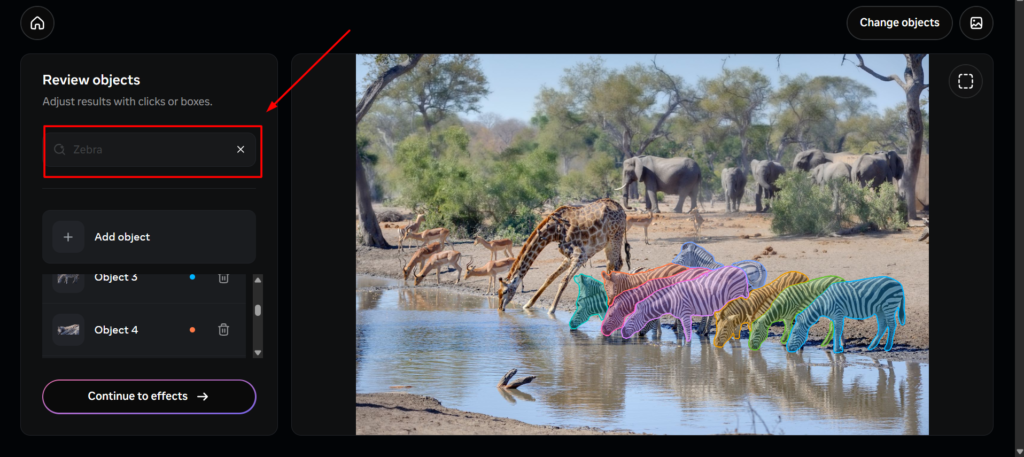
Instead of focusing only on objects, the new models understand visual concepts, motion, and spatial structure.
SAM 3 Understanding Visual Concepts in Images and Video
SAM 3 is a unified vision model that combines detection, segmentation, and tracking into one system. It works across both images and video and goes far beyond identifying static objects.
What makes SAM 3 different is its ability to understand natural language descriptions. You can describe a scene in plain words, such as people sitting down, and the model can locate and track those concepts visually. This means SAM 3 is not limited to predefined categories. It responds to how humans naturally describe what they see.
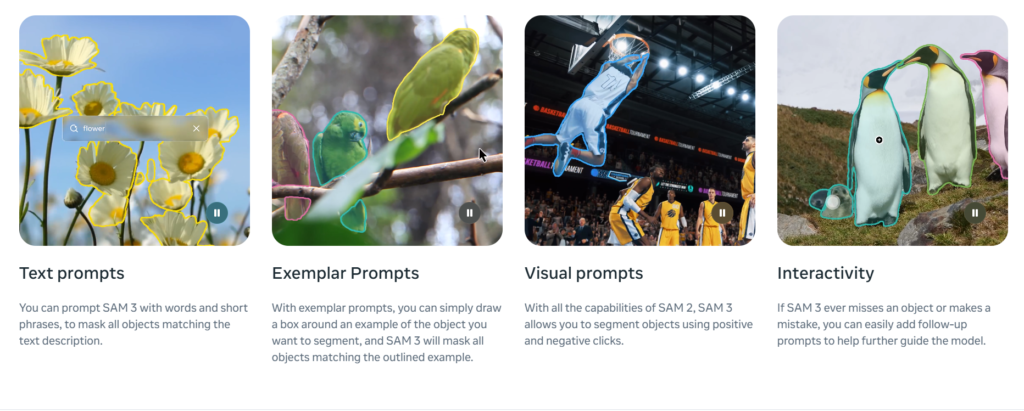
Key capabilities of SAM 3 include:
- Detection and segmentation of any visual concept
- Object and concept tracking across video frames
- Language-guided visual understanding
- No task-specific retraining required
This bridges the gap between human language and raw pixels, making visual AI far more intuitive to use.
From 2D Vision to 3D Understanding SAM 3D
While understanding pixels is powerful, real-world perception also requires depth, shape, and spatial awareness. This is where SAM 3D comes into play.
Meta introduced two complementary models under SAM 3D.
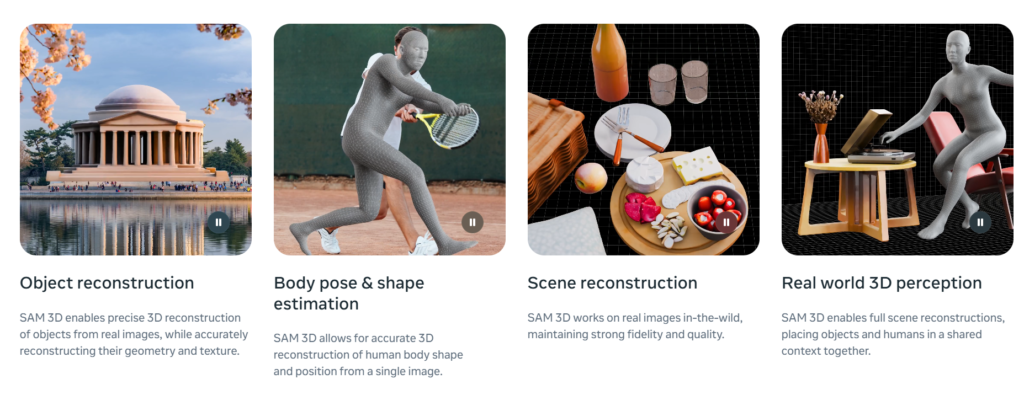
SAM 3D Objects
This model focuses on scene and object reconstruction. After segmenting objects in an image or video, the system can reconstruct them as three-dimensional forms. Objects can be isolated from a scene and represented in 3D space, making them usable for simulation, AR, VR, and digital twins.
SAM 3D Body
SAM 3D Body is designed for human pose and shape estimation. It can accurately infer body posture, movement, and geometry from visual data. This has major implications for animation, gaming, fitness technology, robotics, and healthcare.
Together, these models enable a full pipeline that moves from pixels to concepts to 3D geometry and pose.
Why This Release Matters
Meta did not just release demos. They open-sourced everything, including model weights for SAM 3, SAM 3D Objects, and SAM 3D Body. This gives developers, researchers, and startups direct access to state-of-the-art perception technology.
This release also complements Meta’s broader AI ecosystem, including language models like LLaMA, moving closer to truly multimodal AI that understands text, vision, motion, and space together.
Real-World Applications
The impact of SAM 3 and SAM 3D spans multiple industries:
- Design and content creation. Faster masking, object tracking, and 3D asset creation
- E-commerce. Product visualization in 3D and interactive previews
- AR and VR. Real-time scene reconstruction and body tracking
- Healthcare. Human motion analysis and medical imaging
- Robotics and autonomous systems. Spatial awareness and environment understanding
- Video and film. Advanced effects, motion capture, and scene editing
What This Means for Creators and Developers
For freelancers, designers, and developers, these models dramatically reduce the complexity of advanced visual workflows. Tasks that once required specialized pipelines can now be achieved using a single open-source foundation.
The real opportunity lies in experimentation. Meta has made the tools available, the demos are live, and the models are hosted on GitHub. This opens the door for new products, creative tools, and applications that were previously out of reach.
Final Thoughts
Meta’s latest SAM release is not just an upgrade. It represents a shift toward AI systems that understand the world more like humans do. By connecting language, vision, motion, and 3D structure, SAM 3 and SAM 3D redefine what visual AI can achieve.
As adoption grows, these models are likely to become foundational technology across design, marketing, spatial computing, and automation. The next wave of innovation will come from how creators choose to use them.
Frequently Asked Questions (FAQ)
1. What is Meta SAM in simple terms?
Meta SAM, short for Segment Anything Model, is an AI system developed by Meta that can identify, separate, and understand visual elements in images and videos. It allows machines to recognize what is happening in a scene without needing task-specific training.
2. What is the difference between SAM, SAM 3, and SAM 3D?
The original SAM focuses on segmenting objects in images.
SAM 3 expands this by adding detection and tracking across images and videos using natural language descriptions.
SAM 3D goes a step further by understanding depth, shape, and spatial relationships, enabling 3D object reconstruction and human pose estimation.
3. What makes SAM 3 different from traditional computer vision models?
SAM 3 is not limited to predefined object categories. It understands visual concepts described in plain language and can detect and track them across video frames. This makes it far more flexible than traditional models that require fixed labels and retraining.
4. What are SAM 3D Objects and SAM 3D Body used for?
SAM 3D Objects is used to reconstruct scenes and individual objects in three dimensions after segmentation.
SAM 3D Body focuses on estimating human pose and body shape from visual input. Both models are useful for AR, VR, animation, robotics, healthcare, and simulation.
5. Are SAM 3 and SAM 3D open source?
Yes. Meta has open-sourced the model weights and research code for SAM, SAM 3, and SAM 3D. This allows developers, researchers, and companies to freely experiment, build applications, and create new products on top of these models.
6. Do I need advanced AI knowledge to use SAM?
For basic experimentation, no. Meta provides live demos and example implementations that make it easy to try the models. However, integrating SAM into production applications does require programming and machine learning knowledge.
7. How can designers and marketers benefit from SAM?
Designers can save time on masking, background removal, and object tracking.
Marketers and e-commerce brands can create cleaner visuals, better product previews, and even interactive 3D experiences, improving engagement and conversions.
8. Can SAM be used for video editing and motion tracking?
Yes. SAM 3 supports tracking visual concepts across video frames, making it useful for video editing, motion graphics, VFX, and content creation workflows.
9. How does SAM fit into Meta’s broader AI vision?
SAM is part of Meta’s larger push toward multimodal AI systems that understand text, images, motion, and space together. Combined with language models and spatial computing research, SAM helps move AI closer to real-world perception.
10. Is there any risk or concern with this technology?
As with any powerful perception technology, concerns include privacy, misuse, and ethical deployment. Responsible use, clear policies, and transparency are important as these models become more widely adopted.